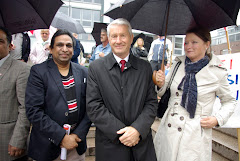
Veddhas want equal status----------- by Dinasena Rathugamage
The Convenor of the Descendents of the Yaksha and Naga tribes in the country, A.N.P. Devanayagam, has sent a memorandum to the President with six demands.
The memorandum says that the Veddha clan is not confined to Mahiyangana only and they have a right to co exist with others in any part of the island.
Among the other demands were that the government should appoint a separate minister for the aborigine or the tribal people and monies should be allocated from the national budget for this segment of people in the country at district level.
They also have urged the government to establish a separate university for them to practice the traditional medicine of these tribes, with a cultural centre and transport facilities.
www island.lk
Wednesday, July 15, 2009


Tuesday, July 14, 2009
SRILANKA: Veddahs oppose road through nature reserve...!!!
Veddahs oppose road through nature reserve
The indigenous community of Sri Lanka known as the Veddahs, are objecting to a highway that is being built through a nature reserve.
Uruvarige Vanniyaleththo, the chief of this indigenous community, told the BBC Sinhala service that forest department officials had prevented Veddahs from entering their late leaders resting place in the ‘Maduru Oya’ National Park.
“These officers did nothing to prevent the building of a road through the nature reserve” he added.
The head of Sri Lanka’s autochthonous inhabitants claimed that road construction work in the reserve would destroy its vegetation.
“It is a threat to birds, animals and our own existence” he said.
According to the head of the Veddahs, the road which connects the Padiyathalawa – Mahiyanganaya road with Kandagammana is going to be 30 feet wide. Two miles of the road will pass through the forest reserve.
“I am not opposed to the development of Sri Lanka, but all indigenous people object to the destruction of our natural reserves in the guise of development,” he said.
Speaking to BBC Sandeshaya, Mr. W. B Ekanayake, the Deputy Minister of Highways said, “Although I am aware of the construction of this road I don’t know who is responsible for it”.
“I will have more details on Monday and I expect to speak to the media on Monday with more details”, He added.
Maduru Oya was declared a nature reserve by the government in 1983.
Situated in the dry zone, about 300 km. from Colombo and spread over 58,849 hectares of land, Maduru Oya is home to several endemic bird species as well as other wild animals.
(BBC Sinhala)
Sunday, June 7, 2009
RACIST ATTACK ON INDIANS IN AUSTRALIA.......!!!
7th June 5.30 pm
In Australia, many of Asian ehthnic origin ( Indians ) are subjected to insults and injuries in the recent past.
Professor Carl Belle Vadivella of Adelaide, (a Muruga devotee, President of the Adelaide Vinayagar temple),who did his annual Thaipoosam Kavadi at Battu Caves in Malaysia for the last 15 years without a break ( wrote a book of over 500 pages on Thaipoosam Kavadi Festival ) brings out an objective analysis of the real causes and the background to the catastrophe. It is worth the while pondering over.
Thank you.
V.Sivasupramaniam
Seychelles
---------------------------------------------------
----- Original Message -----
From: Carl and Wendy Belle
Sent: Friday, June 05, 2009 3:34 PM
Subject: Curry bashing: a Perspective
I am sorry to write a group email, but I am alarmed at how a particular issue has got completely out of hand, and has become the subject of some hysteria in the press, especially in India. And this is the issue of so-called "curry bashing", that is, attacks on ethnic Indians in the cities of Melbourne and Sydney.
Basically the issue is as follows. Over the past two years there have been a number of attacks on ethnic Indians, mainly in Melbourne, but also in Sydney, and to a lesser extent in Adelaide. Much has been made of this, and I have read comments about the "white trash" and "racist Australia". The truth is more complex than this.
When I was Hindu chaplain at Flinders University, I became aware that there were a number of attacks on Indian students in the northern suburbs of Adelaide. When I enquired with the police I found out that the attacks were mainly mounted by Aboriginal gangs, and Indians were targeted because they were easily identifiable and because it was believed that they were wealthy. Normally they also carried mobile phones and laptops, which were items which could easily be converted into cash. (However, these gangs were also targeting isolated rural homesteads and other individuals; it wasn't just Indians).
With the recent round of attacks in Melbourne, the Victorian police have refused to release details of the identity of the attackers. This has made many people think that it is white supremacist groups involved. However, I have made my own enquiries, and I have found that while some of the attackers are "white", the majority are ethnic gangs, mainly of second generation immigrants.The police apparently do not wish to identify the groups (the same groups have created similar trouble in Sydney, and are just as likely to target white Australians - who they call "skips" (after the TV series, "Skippy, the Bush Kangaroo").
Why are Indians targetted? It seems because many are believed to be rich, and many display items such as mobile phones ands laptops which can be quickly converted to cash on the open market. Moreover Indian students are hardworking and often work long hours in jobs which require them to travel late at night or work in isolated locations or high risk jobs (petrol stations, hospitals, all night supermarkets, etc)
Moreover, many students who come to this country have no idea how violent Australian society is. I have repeatedly told new students that they must exercize care at night, especially in the more lawless suburbs - the northern suburbs of Adelaide, the western suburbs of Melbourne and Sydney. Many students imagine that because Australian is a "European" country, it is safe and that we are all law abiding. Our crime rates in some parts of Australia are a national disgrace. Most of the violent robberies and bashings in Australia (up to 80 per cent) are committed by drug addicts, and the most vulnerable and frequently assaulted targets are not ethnic Indians but elderly middle class Australians of all backgrounds. I have impressed this on all Indian students of my acquaintance - to be careful of their personal safety, especially at night.
There is racism in Australia, as there is in every country round the world. White supremacist groups do exist, as they do in North America and in Europe, but they have little impact upon public policy, and they tend not to be openly violent. (And interestingly their leadership tends to be British or Irish immigrants) But this is a country where people of any ethnicity can make a successful career, and where Indian immigrants often occupy upper level positions in the professions and business. (A huge percentage of postgraduate students are of Asian background and our IT sector would collapse without Indians.) In Adelaide our most recent mayors have included an ethnic Chinese, an Arab, a Jew and now an Anglo-Celt. The Lieutenant Governor of this state arrived as a refugee by boat from Vietnam. My son-in-law's parents fled China during the Cultural Revolution, and all have made successful careers in Australia. To label Australia as a "Country of Racists" is not only stupid and offensive - it is plain wrong.
Let me quote something that was stated during a recent election campaign. "I want you to go out and find places where Satan has his strongholds: mosques, Hindu temples, Buddhist temples, bottleshops, and Casinos, and destroy these places. We want a Christian Australia." Guess who said this? Pastor Danny Nelliah, a Tamil migrant from Sri Lanka, a leader of the Pentecostalist group Catch the Fire Ministry, and a Senate candidate for the Pentecostalist front Family First Party. And this is the most likely area where Hindus, Sikhs, Muslims, Buddhist and Jews have to fear organized hatred. Pauline Hanson got much of her support from fundamentalist Christians, who are just as likely to be immigrants as native born Australians. (The leader of the violent National Front white supremacist group in Perth had an Indonesian mother, and many of the Family First membership are ethnic Chinese and Koreans.)
In 1983, after I had taken my third kavadi in Malaysia, I received a letter from a Christian group in Perth.This group accused me of betraying my Christian upbringing and told me that I would go to hell. I guess, I was stupid; I responded, I was already in hell; I was working in Canberra. The letters continued, until I finally got one which was openly threatening - it stated that the writers knew where I worked, they knew were my wife worked, they knew where my children went to school, and they had friends who would deal with me. When I took this letter to the Canberra police, they police traced the letter down to an Assemblies of God church in Fremantle (Perth). The pastor of this church was from the subcontinent.
The hysteria which has broken out in the Indian press is not helpful. Most Australians are horrified by the idea of racist attacks, (or attacks which might be interpreted as racist), and Kevin Rudd, our Prime Minister, is the first leader we have had who speaks Asian languages. Burning effigies of Rudd is just stupid. (We had the same hysterical reaction after Australia won a controversial cricket test in Sydney in January 2008; I wonder why these rent-a-crowd people are not protesting against real and systemic and often violent injustices against Indians in places such as Kenya, Fiji, Burma, etc. And Indians in Australia do not die in police custody) Of course, Australians are not immune from this hysteria. We had the same thing in this country when convicted drug pusher Schapelle Corby was jailed by a Bali court, and when drug dealers Chambers and Barlow were executed in Kuala Lumpur.
In 2007 my wife, Wendy, was mugged by a gang just off Petaling Street in Kuala Lumpur. This was in broad daylight. Given that she had just recovered from an illness, it was a miracle she was not injured. Later a senior Malaysian policeman told us that "white" visitors were the special target of these gangs, particularly those who appeared middle aged or older. Was this racism? No: it was the fact that "white" tourists are seen as soft targets. Does this make me anti-Chinese, or will I be immature enough to go out and burn Malaysian flags or effigies of the Malaysian PM? of course not. Most Malaysians who heard of this incident were horrified, and I know most Malaysians - whether Malay, Chinese or Indian, to be kind, generous and welcoming. As are most Australians. And of course the main victims of Chinese gangs in Malaysia are...other Chinese.
Just one final issue. Most Indians who study in Australia come with the express purpose of getting Permanent Residence. I note that all of those interviewed on TV after last weeks demonstration stated that they still intended to do so. If this country was as vicious and unpleasant and as racist as the Indian press seems to imply, one would have imagined that Indian students would leave as soon as possible. Many Indians who have come to this country have come from regimes where they have experienced real injustice and often appalling violence - countries like Sri Lanka, Fiji and apartheid era South Africa. I have worked with these people, and I am proud to call such people my friends. Racism, bigotry and intolerance must be opposed wherever they appear. These qualities appear in every country around the world - Australia is no exception. But while the attacks on Indians in Australia may contain a racist element, from the information passed to me most of them are not racist attacks. I pass this on in a hope that the hysteria which has surrounded this issue can be put to one side or at least viewed in some sort of perspective. In general Indians in Australia are as safe as any other Australian.
Aum Shanti,
Carl Vadivella Belle
Wednesday, May 13, 2009
BRITAIN TOO NOT SUPPORT IMF LOAN TO SRILANKA!!! DEMAND TO STOP WAR/ SUFFERINGS OF TAMIL CIVILIANS!!!
IMF bailout suspended?
Stocks down, Rupee loses ground
Sri Lankan shares came down Tuesday on fears that a 1.9 billion Dollar International Monetary Fund bailout may be delayed, while the Rupee weakened against the dollar, brokers and dealers said. The Rupee opened at 117.05/117.25 and fell to 117.25/0117.45 levels by late afternoon trade.
The All Share Price Index closed down 0.60 percent (11.47 points) on the stock market to end at 1,888.62 while the Milanka index of liquid stocks closed up 0.14 percent (2.80 points) to end at 2,051.53, according to provisional stock exchange figures. Turnover was almost 180 million Rupees. "The concerns over the IMF facility and profit taking dragged the market down," said Geeth Balasuriya of Acuity Stockbrokers. "However, during the latter part of the day, the indices recovered on bargain hunting by mainly retail investors".
British Foreign Secretary, David Miliband, indicated Britain does not support Sri Lanka's request for the IMF loan, when he spoke to the media about the situation in the island ahead of a meeting at the United Nations on Monday.
"I think you'll find that the issue is not coming up at the IMF today," Miliband said when asked whether the UK supports the IMF loan application by Sri Lanka.
"It's essential that any government is able to show that it will use any IMF money in a responsible and appropriate way and, as I explained in the House of Commons last week, I don't think that is yet the case (in Sri Lanka)."
Britain and other western powers and Sri Lanka's main aid donors have been pressing for a halt to the government offensive against the Tamil Tiger remnants, to try to avoid civilian casualties.
Trading in Janashakthi Insurance shares in the meantime was temporarily halted on the Colombo bourse after the Insurance Board of Sri Lanka suspended its licence for three weeks and stopped it from issuing new general and long term (life) insurance policies. Janashakthi closed flat at 8.00 Rupees.Conglomerate John Keells Holdings, which has interests in finance, transport, property development, food processing and retail sectors, lost 25 cents to close at 77.00.
Market index heavy fixed line giant Sri Lanka Telecom lost 25 cents to close at 39.00 while National Development Bank lost 2.25 rupees to close at 93.00, while Hatton National Bank lost one rupee to close at 94.00. Tokyo Cement lost 4.00 rupees to close at 135.00 on thin volume trade. Sri Lanka's largest privately held bank, Commercial Bank of Ceylon,
lost 2.00 rupees to close at 94.00. Ceylon Tobacco Company, a local unit of British American Tobacco lost 3.75 rupees to close at 115.25, while Distilleries Company of Sri Lanka gained 1.75 rupees to close at 82.25. - LBO
DAILYMIRROR.LK
Saturday, May 9, 2009
MUSLIMS TOO TARGETTED TIME TO TIME BY COLOMBO GANGS!!!NO SAFETY FOR ALL MINORITIES AT ALL!!!SRILANKA: A BRUTAL RACIST POLICE TOO!!!

MALIGAWATTE MAYHEM
By Kurulu Kariyakarawana
At least one person was killed and nine injured when an armed gang opened fire at crowds who were coming after Friday prayers from the Maligawatte Jumma Mosque, police said.
They said according to initial investigations it appeared to be linked to rivalry among underworld gangs in the area.
An armed gang of about six had stormed the Mosque on Jumma Masjid Road in Maligawatte around 1.30 pm and started searching for a person or group who were believed to have been engaged in routine Friday prayers.
The gang had reportedly come in a vehicle while three of them had been armed with rifles similar to T-56 weapons. They had entered the Mosque while the prayers were almost coming to an end.
They had started looking for somebody and had pacified the frightened people saying they would not be harmed, an eyewitness said.
Meanwhile the remaining members of the group who were outside the Mosque had entered into a small passage leading to a row of houses and started firing at a person.
All the armed men had then started firing at crowds gathered outside the Mosque after prayers and had fled the scene.
Police Spokesman Ranjith Gunasekara told the Daily Mirror that the injured were rushed to the National Hospital and one of them had reportedly died on admission.
The victim had been identified as 30-year-old M Sadal – a butcher believed to be living in the Jumma Masjid Road area.
Unconfirmed eyewitness accounts revealed that one of the armed intruders was also injured in crossfire when another group had retaliated.
A large number of spent cartridges believed to be of T-56 rifles were found scattered along the road.
............................................................................
Muslim leaders condemn attack
By Kelum Bandara and Yohan Perera
Muslim political leaders roundly condemned yesterday’s Maligawatte shooting incident which killed one person and injured nine, and called for the government to arrest the dangerous trend.
SLMC General Secretary MP Hasan Ali said the sanctity of places of religious worship should be preserved, and the government should take steps in this regard. Otherwise, Mr. Ali said this would lead to an unpleasant and complicated situation in the future.
“In the run up to the Western Provincial Council election, there were many underworld attacks in the Maligawatte area. We cannot link this incident to the same underworld groups. At the same time, we cannot rule out such connections either,” he said.
UNP front liner Azath Sally said yesterday’s shooting incident had created a dangerous trend. “Allowing underworld gangs to carry automatic weapons makes the security in Colombo city bleak,” he said.
He said in the wake of these incidents it has become unsafe for Muslims even to go to the mosques in the Colombo City.
He said it was too early to establish any political link to the incident.
Eastern Provincial Council Health Minister M.L.A.M Hizbullah said no one could condone these attacks near a place of religious worship, and the responsibility lies squarely with the government to bring the perpetrators to book
Mr. Hizbullah said this incident bears the hallmark of an underworld conspiracy.
“We are on the verge of finishing off LTTE terrorism. At this hour, we should not allow the underworld to disrupt the country’s normalcy,” he said.
dailymirror.lk
Friday, May 1, 2009
TAMIL EELAM VS KOSOVO.....A COMPARISON!!!
Tamil Eelam Compared with Kosovo
The right to self-determination of the Tamils of Sri Lanka (Ceylon)
by Tamil Centre for Human Rights, March 7, 2008
Kosovo..................Tamil Eelam
Sq. Kilometers10,887 km²....... 19,509 km²
Coastal area ----More than 400 kms
CapitalPristinaTrincomalee
Annexed with Serbia in 1989 Ceylon (Sri Lanka) in 1948
Conflicting peoples Serbs vs Kosovars Singhalese vs Tamils
Population2,000,0003,598,000 (census in 1979) 93% Tamils
Domination bySerbsSinghalese
Military composition 100% Serbs 99% Singhalese in all forces
ColonisationKosovo region by Serbs North East by Singhalese
Settlers?over 300,000 Singhalese colonists
Negotiations started 19891927
Failed negotiations SeveralBetween Sinhala & Tamil leaders 1927, 1971,1977-82,1985, 1986, 1989, 1994, 2003-2006
Abrogation of pacts by state yes
Serbia-EU Unilaterally abrogated by Sri Lanka 1956, 1965, 1987, 2002, 2005
Democratic mandate Sept 1991 & May 1992 1977 general elections - Tamils voted overwhelmingly for independence
Armed conflict March 1998 July 1983 to date
Freedom fighters Kosovo Liberation Army (KLA)Liberation Tigers of Tamil Eelam (LTTE)
Civilians killed over 5,000 over 100,000
Disappearancesover 4,000 over 28,000
Rapes20,000over 12,600
Mass graves 526Numerous
Internally displaced 250,000 single displacement over 800.000 multiple displacements
Refugees61,000over 600,000 in western countries & India
Press & Fredom of Movement DeniedDenied
Property damage figures not known over US$ eight billion
Houses destroyed 128,000over 300,000
Attacks on religious buildings 5002,375 (both Christian & Hindu-Saivite)
Villages demolished figures not known over 500
Political prisoners nearly 2,000 (Dec. 2001) over 3,000 at present
Ethnic cleansing/violence1990Since 1956, esp. 1956 , 1958, 1977, 1981 & 1983 onwards
Economic embargo not enforced since 1987 with a few interludes. now in force.
ForcesArmyArmy, navy, air force, police & auxiliary
CourtsJudicial Development Division (JDD) Tamil Eelam Courts, including an Appeal Court & Law College
Human Rights institutions Ombudsperson Institution of Kosovo North East Secretariat for Human Rights (NESoHR)
Financial institutionsBanking & Payment Authority of Kosovo (BPK) Bank of Tamil Eelam
Education Kosovar education system Education Council of Tamil Eelam
Welfare & sociation institutionsInsitution of social welfare Homes for the aged, widows, children & war-affected adults & children
Violation of signed UN instruments Serbia has not signed many UN treaties Sri Lanka has violated the UN Charter, UDHR, ICCPR*, ICESCR, ICERD, CEDAW*, CAT & CRC*
Visit by High Commis. for Human Rights yes Visited only the Sri Lankan government-administered areas
UN/EU intervention yes NONE
UN resolutions yesNONE
International monitoring yesNONE
Visits by VIPs yesVIPS who met with LTTE leadership:
Spe.Rep of UNSec Gen.Mr Olaru Ottunu-1997
EU Commissioner – Mr Chris Patten
Norway's Foreign Minister & Deputy
Norway's Minister for Intern. Development
Norwegian special envoy – Erik Solheim
Japanese special envoy Yasushi Akashi
US Congressman – Danny Davis
Australian MP – Ms Virginia Judge
Iceland's Foreign Ministry official – Bjarni V
Martin McGuinness – Sinn Fein, North reland
All EU and other Diplomats in Colombo
UNICEF Executive Director
UN Special Representative Allan Rock
UN Spec.Rapporteur–Extra-judicial killings
UN Spe.Rapporteur – Religious intolerance
Head of UN agencies in Colombo
VIP visits prevented----Sri Lanka prevented visits to LTTE-administered areas for:
UN Secretary-General Kofi Annan
His Royal Highness Prince Charles – UK
Ex-Presidents of USA W Bush and B Clinton
Secretary of State, USA
Prime Minister of Canada
Prime Minister of South Korea
Ministers from Japan, Netherlands, Finland, Germany and many other countries
UN High Commissioner for Human Rights
Spec. Rep of UN Sec Gen. Sir Holmes
Spec. Rep of UN Sec Gen on IDPs
UN Sep. Rapporteur on Torture
(Updated from the TCHR reports submitted in March 2001 and March 2007)
ICCPR*- International Covenant on Civil and Political Rights
ICESCR - International Covenant on Economic, Social and Cultural Rights
ICERD- International Convention on the Elimination of All Forms of Racial Discrimination
CEDAW* - Convention on the elimination of Discrimination against Women
CAT - Convention against Torture and Other Cruel, Inhuman or Degrading Treatment....
CRC* - Convention on the Rights of the Child
* optional protocols
BY...............
Sutharshan (Krishna)
P.O. Box 6322, NCD, Boroko, PNG
Saturday, March 7, 2009
PLANTATION TAMIL WOMEN: VIOLATION OF HUMAN RIGHTS!!!
Non -provision of restrooms for plantation women, a violation of their rights
Although it is an accepted concept that men and women are equal, in practice women had lived with less social recognition and with lots of discrimination. The attitudes and the structures that maintain the attitudes that lead to discrimination against women need to be changed. International Women’s Day on March 8, reminds men and women that they are equal and are entitled to equal treatment and respect.
Since discrimination against women has been an issue throughout history, on December 18, 1979 the United Nations General assembly adopted the "Convention on the Elimination of All Forms of Discrimination Against Women" – which is best known as CEDAW and was ratified by the Sri Lankan government on October 5, 1981. The important concept of CEDAW is that "anything or any action that stops women from enjoying the human rights and freedoms (political, economic, social, cultural and civil and other fields of life) that men enjoy, should be considered as discrimination".
Part of article 11 of CEDAW stresses the point that women have the right to "health and public security" and Article 14 too speaks of women as having the right to "enjoy health care services". The purpose of this article is to examine whether the plantation women who remain the back bone of the economy of this country, enjoy at least basic minimum health care and health security.
We could take a basic need of the working women in the plantation as an example. These women work in large open tea and rubber fields. Their homes are normally very far from the place of work. Women have special physical needs and arrangements need to be made to protect their privacy while working, but in the field where hundreds and hundreds of women work, there are no rest rooms or toilet facilities for them. Men too work in the field and they too have some physical needs. The men answer their calls of nature without any problem and the way it is done is accepted by society as normal. But women cannot do this. We need to reflect and see how these women answer their calls of nature and attend to their private physical needs in the absence of rest rooms or toilets.
It is also not unusual to find plantation women sitting under tea bushes or on roadsides to have their tea or meals. These women tolerate such discrimination of a high degree without protest. What does this situation mean? The message is that these women are not treated as human beings. In our country, life patterns and the facilities people enjoy have changed and developed so much. The plantation sector itself too has undergone changes and development. But don’t we feel ashamed to realize that even the most basic needs of these plantation women are not being fulfiled, their right to privacy is not being respected? One cannot only blame the plantation companies and the managements for this state of affairs. The trade unions in the plantations who have more than 50% women among their membership have also not taken this matter seriously.
The demand to provide rest rooms with toilets facilities in the field had been a longstanding one by the people. There had been agreements between the plantation companies and trade unions that rest rooms with toilet facilities should be provided. But these agreements remain a dead letter. Having rest rooms with toilets in the field is not only a basic human right of women, it is also an occupational right. In these circumstances the question arises why this demand has not been met. As stated earlier, more than 50% of the membership of all the plantation trade unions is women. Trade unions consider their female members as mere workers but do not see them as women or as persons with human dignity and with special gender needs. Most trade unions do not have women at any level of decision- making. Gender sensitivity in the trade unions is very low. This makes the trade unions treat their female membership, who pay the same subscription fee as men, in a discriminatory manner.
This is the reason why trade unions did not agitate for the implementation of the provision for rest rooms in work locations. The trade unions need to genuinely accept this and change their attitudes and approaches. It is the responsibility of trade unions to collectively stand up for the basic rights of their female membership. They have a duty to enlighten the people about the agreements, mobilise them and pressurise the plantation companies to provide rest rooms in the field to ensure the basic rights of women.
It would be unfair if I do not mention that a few estates have provided rest rooms for female workers. According to reports, some of the INGOs working in the plantations have contributed towards such projects. Anyway, the number of rest rooms is so very few and therefore negligible. However, the question that needs to be asked here is that if a few of the plantations could provide this facility why not the others? All have the same responsibilities towards their female workers.
Finally, it should be stressed that the demand for rest rooms with toilets is not a mere demand, but is really a demand that the women in the plantations be treated and respected as human beings having dignity. On the other hand, it is a demand for a legitimate right ensured by CEDAW and through the agreements entered into between trade unions and the companies.
M. Pushpakumary
Gender Promoter
Plantation Rural Education and Development Organization
www island.lk
Prabath Sahabandu/editor
Tel:+940112497574
Fax:+940112497543
E-mail:prabath@unl.upali.lkTel:+940112497567
Fax:+940112449291
E-mail:webmaster@unl.upali.lk
Subscribe to:
Posts (Atom)